Ron Sider, president of ESA, to retire

Ron Sider, one of the main characters in Moral Minority, yesterday announced his retirement from Evangelicals for Social Action. He will step down in June 2013 and be replaced by Al Tizon and Paul Alexander (I’ll have more to say about them down the road). Read the news reports here and here.

Here are two excerpts from the manuscript. The first is from the introduction and describes how Sider helped launch the evangelical left of the 1970s:

Ron Sider promoted a Swiss-German Anabaptist strain of progressive evangelicalism. Author of the best-selling book Rich Christians in an Age of Hunger, Sider espoused an ethic of simple living that extended the critique offered by third-world evangelicals. He also followed Senator Mark Hatfield’s lead into electoral politics. In 1972 Sider founded Evangelicals for McGovern, a group that campaigned on behalf of Democratic candidate George McGovern. This effort led directly to the first organized gathering of the evangelical left.

The second is from the epilogue, where I push Sider’s story forward to the present day:

Ron Sider, leader of the Thanksgiving Workshop, continued to preach Anabaptist messages of justice, peace, and simple living to evangelicals. Rich Christians in an Age of Hunger, which catapulted Sider to prominence,sold nearly half a million copies by its fifth edition. As president of Evangelicals for Social Action and a professor of theology, holistic ministry, and public policy at Palmer Theological Seminary, he helped launch the Evangelical Environmental Network. In the early 1990s EEN campaigned for and donated $1 million to preserve the Endangered Species Act and in the early 2000s launched a “What Would Jesus Drive?” campaign, which garnered articles in at least 4,000 media outlets over four months. With the exception of his pro-life stance, support for school vouchers, and 2000 vote for George W. Bush’s “compassionate conservatism” (which he later said he regretted), Sider, like Sojourners’ Jim Wallis, routinely embraced Democratic policies. Yet ESA, characterized by Sider’s warm and conciliatory personality, can be distinguished from Sojourners’ more partisan style. Into the 2000s Sider and his wife Arbutus, a family therapist, still practiced simple living. They cooked out of the More-with-Less cookbook, by then in its 47th printing. They purchased most of their clothes at thrift stores and maintained a modest home in a mostly black neighborhood in the Germantown section of Philadelphia. The décor, reported a journalist, was comfortably worn, falling “somewhere between Graduate Student and Junior Faculty.”
Young evangelicals at odds with political parties

Sojourners just released a new poll of evangelicals under the age of 35. It has a high margin of error, but the results–the relatively high number of independents and the finding that many evangelicals feel politically homeless–ring true to me.

The survey — of mostly single, college-educated evangelicals — showed that 54 percent identified as Republicans, 26 percent as Democrats and 20 percent as Independents or something else.

Of the Republicans, 65 percent said their faith convictions frequently or sometimes conflict with the positions taken by the political party they usually support. That was true of 83 percent of Democrats.

George Marsden and Mark Noll

George Marsden, my graduate adviser, and Mark Noll, my post-doctoral mentor, are two of the top historians of religion. They deserve huge credit in guiding Moral Minority toward publication, and I loved working with them at Notre Dame. If you want to know what they look and sound like, check out this video:

Reviews are coming in

It’s been a banner week here at Moral Minority. Jared Burkholder over at the Hermeneutic Circle posted a three-part interview (here, here, and here) about the book. And two overly kind bloggers reviewed the book. Check out Scot McKnight’s thoughts at Jesus Creed. And head over to the Houston Chronicle’s The Peace Pastor to read how Marty Troyer connects progressive evangelicalism to the city of Houston. Be sure to check out the fascinating comments on both sites. One of the delightful things about writing on a contemporary topic is that activists, pastors, and participants, and actual characters from my book can weigh in (although if you look at the one-star review on Amazon, it’s not always delightful!).

David Gushee and the Common Good

One of the strongest moderate evangelical voices around is David Gushee. He has been heavily involved with the New Evangelical Partnership for the Common Good. He’s the editor of the recently released A New Evangelical Manifesto. And he’s been interviewed recently by Greg Metzger on a Patheos blog and by Krista Tippett this week the radio show On Being. His appearance was part of the show’s Civil Conversations Dialogue on abortion. Our family listens to this terrific show on the way to church every Sunday morning. Here’s a taste:

a healthy evangelicalism brings good news and good Christian love especially to those who have been marginalized, including those marginalized sometimes by evangelicals themselves. So this section offers chapter length treatment of what it might mean to love the trafficked, those suffering from preventable diseases, Muslims, women, children, and so on.

Howard Snyder and “How We Vote”


Howard Snyder

This post by Howard Snyder, who has many connections to Asbury, is a pretty good representation of centrist evangelical thought. He argues that one issue should not trump all others, that a consistent-life ethic should animate evangelical politics, and that climate change is perhaps the most critical issue facing voters. After criticizing libertarians, Republicans, and Democrats he makes this point:

Many of us would happier with a more multi-party system where not every issue gets caught in no-win gridlock. The founders of the U.S. political system envisioned open debate and common-good compromise, not what we have now.

Ben Witherington’s pacifist journey

Check out this fascinating autobiographical post from my colleague across the street at Asbury Seminary. Here’s a taste:

Actually reading the Gospels as a High School student required to read the Bible for my God and Country award, it began to dawn on me that: 1) the Sermon on the Mount was rather important when it came to Christian ethics, and 2) I came to the conclusion Jesus would not have agreed with Richard Nixon about the moral nature of the Vietnam war. Indeed, he would not have agreed with the idea that any of the wars fought by the U.S. in my lifetime were examples of ‘just wars’ or even ‘justifiable wars’.

Jesus, as it turns out was a hard core pacifist and he was serious as a heart attack about that non-resistance, turn the other cheek, take up your cross and be prepared to die at the hands of your enemies stuff. He was, to use an oxymoron, an adamant even a belligerent pacifist. ‘Those who live by the sword die by the sword’ was his warning, and when his disciples tried to take up swords for the sake of the Kingdom Jesus not only told them ‘enough of that’ but he then repaired the damage to the ear of the high priest’s slave. Jesus was in deadly earnest about being the Prince of Peace.

What makes the journey of a pacifist long and hard is because of course you are swimming upstream in America, and sometimes you are swimming against a torrential flood in the other direction. You get used to being called a coward, unpatriotic (and a few unmentionable things), and this is all the more likely to happen to you, because you feel like that deer in the Far Side cartoon (see above). The Amish in one sense, take the easy way out. It would be one thing to live in a conclave of like-minded pacifists. That would be easier (see the movie The Witness). It’s harder to be in the world whilst not being of the world. It’s harder to be a non-sectarian, non-monastic pacifist. It just is.

Now here’s a sexy post–a report on conference reports

For a comprehensive list of reports on the Evangelicals for Peace summit, head on over to Rick Love’s blog.

For a brief report on last week’s Christian Community Development Association meetings, click here.

Launch day

Today is the official publication date for Moral Minority. Other than Penn Press’s release notice, I really don’t know if there’s any significance to the day since the book has been for sale for a week already. So far the book appears to be selling well. Amazon, at least, is out of stock. So if you want to get a copy fast, check with Barnes & Noble (which is less expensive anyway) or purchase it directly from Penn Press. For a 20% discount, provide the promotional code “P4U4” at checkout.

Online chatter about the book is starting to build. Check out some of these links:

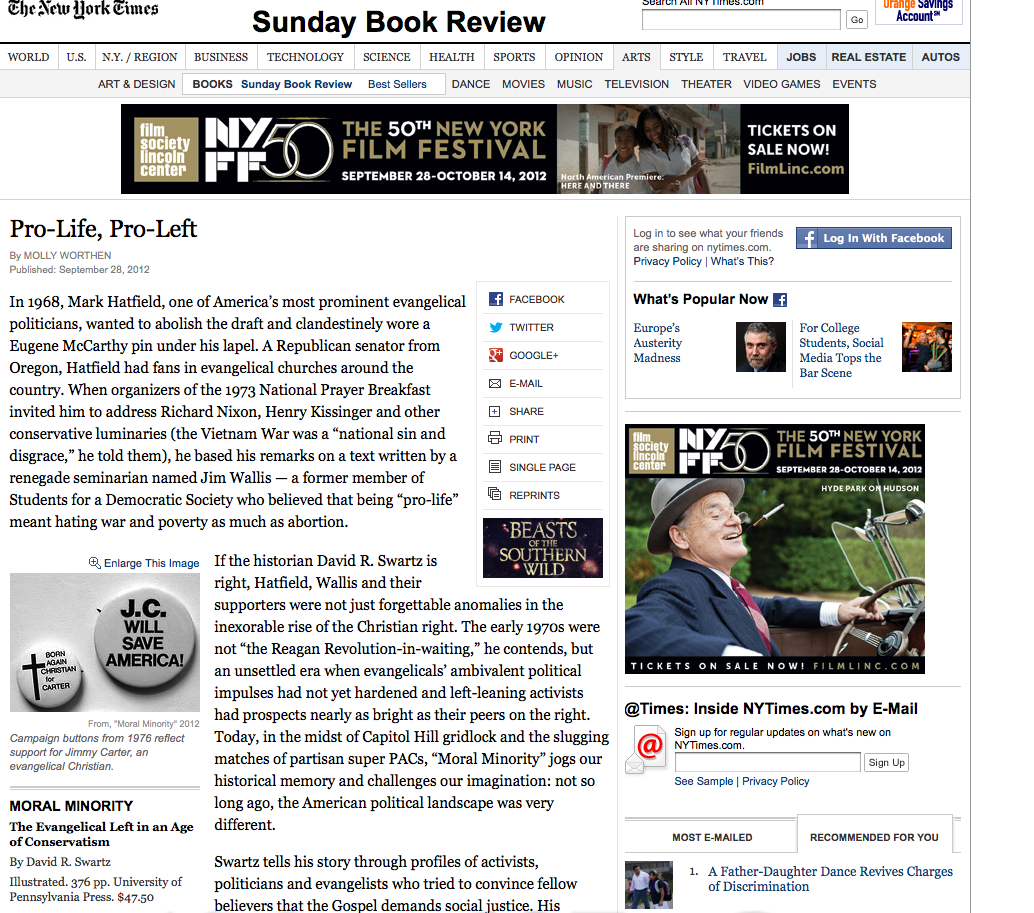
New York Times review

The first review is in–and it’s a big one! Click here for the New York Times review of Moral Minority. The reviewer, Molly Worthen, says that Moral Minority is “a vivid topography of a little-understood corner of evangelical thought” and “a careful work of scholarship” that “jogs our historical memory and challenges our imagination.” More critically, she writes that one of the book’s arguments “is provocative but overstated.” Overall, a good solid review that ends with a perceptive point: that the book can be read as a eulogy “for a political culture that might have been: a Republican Party that might have chosen to attract new voters by promoting progressive social policies rather than pandering to the resentment of Southerners and “white ethnics”; an evangelicalism more evenly split — as Catholic voters are — between the parties, and open to a wider range of solutions to our problems.”

Not too bad, considering this nasty NYT review from a couple of years ago! If you’re interested in a hard copy, it’ll appear in Sunday’s edition of the New York Times Book Review.