Prophetic Evangelicals

Check out this review at Englewood of Prophetic Evangelicals: Envisioning a Just and Peaceable Kingdom, due out next month from Eerdmans. It includes lots of important young and minority voices including Malinda Berry, Peter Heltzel, Bruce Benson, David Gushee, Chris Boesel, and Ruth Padilla-DeBorst, among others. Here is Daniel Yencich’s critical summation to an otherwise very positive review:

For all the strength in its various essays, Prophetic Evangelicals is not without its questionable assumptions and unhelpful assertions. Though there are contributors who resist this trend, Prophetic Evangelicals as a whole seems most at home among those evangelicals who lean to the left, both politically and theologically. What this amounts to at times is a solid critique of conservatism (which is welcome!), but only a rather soft-handed prodding of liberalism (which, frankly, is not enough). Political conservativism and liberalism are both sources and perpetrators of great evil in the world today; a bit more balance in the prophecy against the two sides of the aisle would have been more helpful.

Peacemaking for children

If you have kids, you should really buy David LaMotte’s book White Flour. Steve Knight’s review offers a brief synopsis:

“White Flour” is a poem about a day in May 2007 when a group of Klu Klux Klan members rallying in Knoxville, Tenn., were counter-protested by a group of merrymakers, calling themselves the Coup Clutz Clowns. Cries of “White power!” were countered with cries of “White flour!” “White flowers!” Rather than returning hate for hate, this group drowned out hate with humor, brilliantly illustrating the non-violent actions that overpowered the voices of discrimination that day.

LaMotte is a Quaker peace activist and a singer-songwriter. Here’s a video of him reading the book:

A New Evangelical Manifesto

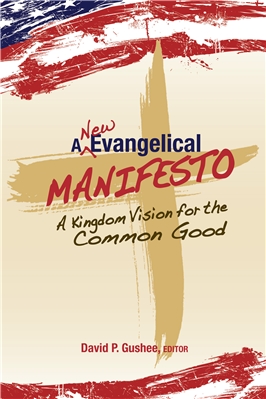
I’ve blogged before about the New Evangelical Partnership for the Common Good. Led by Richard Cizik and David Gushee, the NEPCG is releasing an important new book next month. Publicity copy for A New Evangelical Manifesto says that the book seeks to “think differently about how conservative faith relates to politics.” I expect that it will echo many of the same “consistent life” themes of the old evangelical left, but most of the names are new. I’m eager to read it!

Here’s the Table of Contents:

Introduction. David P. Gushee

Section I: A New Kind of Evangelical Christianity…
1. The Church in America Today (Brian McLaren)
2. Where the Church Went Wrong (Steven Martin)
3. A Disenchanted Text: Where Evangelicals Went Wrong with The Bible (Cheryl Bridges Johns)
4. My Journey Toward the “New Evangelicalism” (Richard Cizik)
5. A Theology That “Works” (Paul Markham)
6. God’s Vision for the Church—Kingdom Discipleship (Glen Harold Stassen)
7. Kingdom Community (Steven Martin)

Section II: Leading to Holistic Love of Marginalized Neighbors, such as…
8. Those Trafficked and Commodified (Jennifer Crumpton)
9. Those Suffering Preventable Diseases (Andi Thomas Sullivan)
10. Our Muslim Neighbors (Rick Love)
11. People of All Races (Lisa Sharon Harper )
12. Women (Jennifer Crumpton)
13. Children (Laura Rector)
14. The Dying (Scott Claybrook)
15. The Global Poor (Adam Phillips)

Section III: …And Redemptive Approaches in Public Life
16: Ending the Death Penalty (Timothy W. Floyd)
17: Making Peace (Paul Alexander)
18: Abolishing Nuclear Weapons (Tyler Wigg-Stevenson)
19: Overcoming Global Warming (Jim Ball)
20: Reducing Abortion (Charlie Camosy)
21: Resisting Consumerism (Jennifer Crumpton )
22: Standing Fast Against Torture (David P. Gushee)

On the decline of liberal religion


Ross Douthat, conservative columnist for the New York Times

In his July 14, 2012, column, “Can Liberal Religion Be Saved?” Ross Douthat mourns a lack of religious options. He indicts liberal religion for its relativism and secularism. He paints conservative religion as compromised by a heretical health-and-wealth theology. But this dichotomy betrays a lack of imagination. Obscured by the unrelenting culture wars, an evangelical left has sought for several decades now to pave a third way. Theologically conservative, but politically progressive evangelicals have allied with moderate Catholics around a “consistent life ethic.”  They have defied political orthodoxies in their attacks on abortion, capital punishment, poverty, nuclear proliferation, and spiritual malaise. In an era plagued by the dislocations of modernity and the relativism of postmodernity, mainliners and fundamentalists might do well to follow the lead of progressive evangelicals in emphasizing both social reform and personal conversion.

For similar thoughts by Rachel Held Evans, click here.

And here Diana Butler Bass points out that liberals are not the only ones losing adherents. Conservatives are too.

Duh!

Michael Westmoreland-White

Michael Westmoreland-White responds with a “Duh!” to my claim that the evangelical left hasn’t thrived became of their discomfort with the very term evangelical. And he follows with a very helpful biographical narrative and expansion of the basic point. Go check it out here.

Is this surprising? When I was a teen in the 1970s, it was fairly easy to call myself “evangelical” and to identify with the Evangelical Left as it was then: Jim Wallis, Joyce Hollyday & the Sojourners Community; Tony Campolo; Ron Sider & Evangelicals for Social Action; Koinonia Partners in Americus, GA, founded in 1942 by Clarence & Florence Jordan & Martin & Mable England as an interracial Christian community–in the midst of segregation and racism; Jubilee Partners and The Other Side magazine (1965-2005); Virginia Ramey Mollenkott; Nancey Hardesty; Letha Dawson Scanzoni–Biblical feminism and the Evangelical Woman’s Conference (now the Evangelical and Ecumenical Woman’s Conference); the radical Black evangelism of Tom Skinner, John Perkins (and Voice of Calvary Ministries), and William E. Pannell–these and other people and organizations were the Left wing of American Evangelicalism, but clearly recognized as evangelical by their more moderate and even conservative sisters and brothers.

I LIKE the term “evangelical.” It literally means “gospel centered” & I, like most Christians, want to be “gospel centered.”. . . BUT “I am NOT “evangelical” in the sense the word aquired after the Furndamentalist-Modernist controversy of the 1920s and definitely not in the sense of the Religious Right. And my theology, while having many influences from the Evangelical tradition as described above, has other influences too: from the Anabaptist tradition and the Anabaptist strand of the Baptist faith, from the more Christocentric strands of Protestant liberalism, from some forms of Neorthodoxy and the post-WWII “Biblical Theology” movement, from Liberation theologies and theologies of Hope, etc.  If one has to avoid all such influences to be genuinely “Evangelical, then I am NOT Evangelical.  If one must be conservative politically, then I, a Green-leaning democratic socialist and registered Democrat, fail the test.

Richard Mouw and the evangelical label

Richard Mouw, president of Fuller Theological Seminary

One of the reasons for the failure of the evangelical left to thrive is that many are uncomfortable with the evangelical label. Associating the label with right-wing, militant rhetoric, many progressive evangelical now call themselves other things entirely, even though they might agree with Richard Mouw’s description of evangelical identity below:

The important question that we do need to ask about labels, of course, is whether they continue to communicate what they were originally intended to identify. In that regard, questions about the “evangelical” label are good ones to ask today. And while I take those questions seriously, I am firmly committed to sticking with that label as a means of self-identification. . . . For me evangelical identity points to such things as a firm belief in the supreme authority of the Bible and the unique atoning work of Jesus Christ, as well as to the obligation to work actively in inviting people to enter into a personal relationship with the Savior. And furthermore, it means continuing to plead with others who own the label not to pile onto those important convictions a lot of additional baggage that does not do honor to a label that I continue to love.

Click here for more.

Evangelical, Republican, Progressive

Mark Hatfield, a progressive Republican senator from Oregon

This guy reminds me of Senator Mark Hatfield, a progressive Republican in the vein of Abraham Lincoln and Theodore Roosevelt, not Sarah Palin and Rick Perry. “My faith,” writes Frank Fredericks in the Huffington Post, “informs my worldview, and that includes a belief that everyone should have a fair chance at success, that we should build more bridges than bombs, and that no interest should be a special interest. . . . Theodore Roosevelt was the first presidential candidate to run on progressive platform, with the Square Deal including consumer protections, challenging corporate monopolies and creating environmental protections. It wasn’t just smaller government, but better government.” Sounds a lot like Hatfield, who feared the emergence of evangelical right-wingers like Palin and Perry–and Robertson and Falwell before them.

Here’s an excerpt from Moral Minority on Hatfield’s early politics:

As Hatfield’s meteoric rise in Oregon politics progressed, it became increasingly clear that he represented a progressive wing of the party of Lincoln. To be sure, he was still a Republican. In fact, Hatfield was an unambiguous social conservative on abortion before the party itself became more consistently pro-life. He was also an anti-New Deal fiscal conservative. But his populist call for “genuine political, economic, and ecological self-determination” meant reducing “excessive concentration of power” everywhere, not only in the executive branch of government and labor unions, but also in big corporations and the military. Hatfield’s emphasis on decentralization, voluntarism, compassionate globalism, political localism, and populist electoral measures such as the recall, initiative, and referendum in fact dovetailed nicely with Oregonian tradition. Hatfield often cited his state’s historic leadership in women’s suffrage, child-labor laws, worker benefits, and the progressive income tax. He opposed a state sales tax, arguing that it was a regressive tax that hit low-income earners disproportionately. He sought and received labor support, earning the endorsement of the Teamsters in his 1952 run for the governorship. Hatfield’s leadership of the Young Republicans in Oregon in 1949 resulted in a platform that included aid to the poor and elderly, taxes on the timber industry to fund environmental research, and an end to racial discrimination. Dismissing the racial overtones that plagued much of the growing conservative movement at mid-century, Hatfield joined the NAACP. In 1953 he successfully introduced a bill that prohibited discrimination in hotel accommodations well before national and most state initiatives. Most Oregon evangelicals supported these initiatives; after all, they came from a governor who regularly stopped his state vehicle to kneel on the roadside to pray.

Red Letter Christianity

There’s a new Christian television show–but it looks a lot different than the 700 Club. “Red Letter Christianity” features evangelical lefty notables Tony Campolo and Shane Claiborne. It airs Mondays at 9:00 p.m., Tuesdays at 2:30 a.m., and Fridays at 12:30 p.m. on TBN. You can watch  previous episodes online here.

I wonder if this is the first-ever progressive evangelical television show. Can anyone think of another?

Wikipedia Wars–the ultimate nerd computer game

Readers of this blog–who are almost certainly scholarly nerds like me–will enjoy this rousing game of Internet research that’s sort of like Seven Degrees of Separation. In WikiWars players must race from a page on Wikipedia to another seemingly unrelated page on Wikipedia using only Wikipedia links. I love the play-by-play!

Peter Gillquist and the road from evangelicalism to Antioch

Christianity Today reported that Peter Gillquist died on July 1. Gillquist, a former evangelical with ties to Dallas Seminary, Wheaton College, and Campus Crusade, converted to the Orthodox church. He also had connections with progressive evangelicals Jack Sparks and members of the Christian World Liberation Front.

Gillquist represented a much larger groundswell of evangelical interest in the early church fathers. See, for example, Robert Webber’s Evangelicals on the Canterbury Trail (1985) and Ancient-Future Faith (1999).

This desire to supplement–and in some cases, supplant–evangelical identification was part of a trend in the 1970s toward identity politics. Carl Henry, in particular, mourned in Evangelicals in Search of Identity (1976). Here’s part of my analysis in Moral Minority:

Other identities also undermined the evangelical left. High-church traditions such as the Eastern Orthodox Church and the Anglican Church poached surprising numbers of young evangelicals. Loyalties to mainline, Lutheran, charismatic-Pentecostal, and holiness traditions also destabilized the movement. Foy Valentine, a progressive Southern Baptist from Texas, told a Newsweek reporter he did not want to be identified as an evangelical. Irritated by the northern hegemony of neo-evangelicalism, he declared that “evangelical” was “a Yankee word.” “They want to claim us because we are big and successful and growing every year. But we have our own traditions,” Valentine explained. Notwithstanding the sociologist Robert Wuthnow’s suggestion of a “restructuring of American religion” along liberal-conservative lines, old denominational and theological categories still remained salient within the evangelical left. Even evangelical identity itself hurt the evangelical left. Despite overtures from some mainliners and some ecumenical cooperation, many in the evangelical left remained suspicious of their longtime Protestant rivals. Bill Pannell, an evangelist with Tom Skinner Associates, mocked mainline spirituality. Their social declarations were entirely derivative from secular politics, Pannell noted derisively at the second Workshop, and the most salient element of their social conferences was the predominance of “really stylish hairshirts.” Another Workshop participant criticized the “mealy-mouthed pieties of liberal Protestantism,” which merely echo “the false values of Americanism.” Cooperative efforts, which seemed promising at first, did not lead to productive co-belligerency. . . .

Carl Henry’s declension narrative failed to recognize already entrenched diversities within evangelicalism. In the 1950s and 1960s evangelical boosters had very effectively created the illusion of a single evangelical identity. The rise of Christianity Today and the National Association of Evangelicals, however, masked the reality that evangelicalism was a coalition of people with some traits in common but also with significant differences. Henry and others so remarkably succeeded in portraying a unified evangelicalism that the secular media in the 1970s fell over themselves to proclaim a “blossoming evangelical movement.” A vital evangelical center, however, would fail to emerge. Identity politics within the evangelical left exposed the illusion of evangelical unity and suggested that the progressive evangelical front might not thrive.

Have any of you taken the trail to Rome or Antioch instead of Wheaton or Colorado Springs?