John Perkins and the trajectory of the CCDA

John-PerkinsA major character in Moral Minority is John Perkins, founder of the Christian Community Development Association. This fascinating profile tracks changes within the CCDA, which now boasts 10,000 members and 1,000-plus organizations, over last couple of years. The author says there is a “new and systemic” approach. The new emphases include creation care, theology, Native American issues, and immigration. Here’s an excerpt:

Historically, CCDA members have sought justice and mercy within the scope of their own neighborhoods. But as they have listened to their neighbors, they find they are affected by social and economic policies far beyond their zip codes. For instance, Castellanos says, many members have found that “banks aren’t lending in the same way to [their neighborhoods] as they do in other communities.” Education and immigration are national issues that have real-time implications in neighborhoods with a CCDA presence. CCDA is coming to realize its own collective power to advocate on public policy issues that affect the neighborhoods where members live. “We weren’t looking for issues to get involved in,” says Castellanos. “We were simply looking at [the systemic challenges] facing our neighborhoods.”

Why care so much what white evangelicals think?

ArleneSanchezWalsh_bioAsks Arlene Sanchez-Walsh, a professor at the evangelical Azusa Pacific University. It’s a great question, one that I’ve been thinking while finishing Moral Minority. Since when is a faith tradition, especially one that thinks of itself in terms of a global communion, defined by race? Here’s more:

One of the things I do, as a matter of record as an academic and as one of a small number of Latina Pentecostal scholars of religion in the academy is I try not to engage those conversations because I refuse to keep the narrative of evangelical meaning white alive–it is time for that narrative to die–and I am trying to do what I can to exhaust whatever oxygen is left in that storyline-but like Hollywood, some storylines refuse to die. Considering one of this past elections’ major themes–that the demographic future of the U.S. is diverse–and for Latinos/as at least, they are more Democratic than their parents, I am surprised that so many scholars, religion journalists, and interested parties are still looking at evangelicalism–as if it was ever white–clearly any look at the history of the black church, of the native American church makes such narratives useless–except that for some reason, they have not been rendered obsolete.

Moral Minority in the news

Boston-Review-logoEven though the Democrats essentially dropped their outreach to white evangelicals over the last year or so–and white evangelicals responded by dropping support for Obama, lots of people are still very interested in the evangelical left. Click here to see the growing list of reviews and interviews. And here are a couple mentions from the last week or so:

Russian Family Completely Isolated for 40 Years

karpagafia1
Karp Lykov and his daughter Agafia, wearing clothes donated by Soviet geologists not long after their family was rediscovered.

I found this fascinating story from Smithsonian during the interminable power outage/Ravens wipe-out. Things have gotten more interesting, so you may want to wait until later.

Here’s a taste of “For 40 Years, This Russian Family Was Cut Off from All Human Contact, Unaware of World War II”:

beside a stream there was a dwelling. Blackened by time and rain, the hut was piled up on all sides with taiga rubbish—bark, poles, planks. If it hadn’t been for a window the size of my backpack pocket, it would have been hard to believe that people lived there. But they did, no doubt about it…. Our arrival had been noticed, as we could see.

The low door creaked, and the figure of a very old man emerged into the light of day, straight out of a fairy tale. Barefoot. Wearing a patched and repatched shirt made of sacking. He wore trousers of the same material, also in patches, and had an uncombed beard. His hair was disheveled. He looked frightened and was very attentive…. We had to say something, so I began: ‘Greetings, grandfather! We’ve come to visit!’

The old man did not reply immediately…. Finally, we heard a soft, uncertain voice: ‘Well, since you have traveled this far, you might as well come in.’

Justice Conference, February 22-24

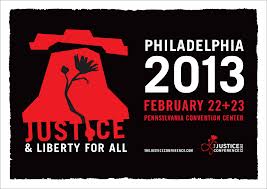
justiceThe Justice Conference is coming to Philadelphia in late February. Speakers include John Perkins, Gary Haugen, Shane Claiborne, Brenda Salter McNeil, Lisa Sharon Harper, and Eugene Cho.

Here’s an invitation from Shane Claiborne:

David Gushee tries to say something new about abortion

Check out these posts by David Gushee, a prominent progressive evangelical and professor at Mercer:

Here’s a taste:

Neither our political nor our moral philosophies can find anything to celebrate in the estimated 1.2 million abortions performed annually in the US.

To the contrary: there is some kind of social pathology at work here. Abortion has become a massively institutionalized response to a grave set of underlying social conditions. Recognizing this gives us the possibility of initiating a meaningful response to those factors.

Redfern welcomes the “new old” evangelicals home

Charles Redfern rejoices “that the militancy is finally melting as it shrieks. I see hope. Evangelical Christianity can rid itself of civil religion, come back home, and become genuinely renewed.” It’s slow-going, and I’m often misunderstood, says this progressive evangelical, but there’s hope that evangelicals are leaving the religious right.

Here’s more:

My Democratic town committee questioned me on my pro-life stance before electing me; some in the Religious Right think people like me have made a pact with the Devil: we’re the enemy, veritable wolves. Others are just baffled. But confusion is inevitable in this era of shrieking, melting militancy. In fact, given the potential for a real homecoming and genuine renewal, confusion is good – as long as we laugh.