
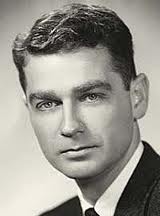
Evangelical, Republican, Progressive

Mark Hatfield, a progressive Republican senator from Oregon

This guy reminds me of Senator Mark Hatfield, a progressive Republican in the vein of Abraham Lincoln and Theodore Roosevelt, not Sarah Palin and Rick Perry. “My faith,” writes Frank Fredericks in the Huffington Post, “informs my worldview, and that includes a belief that everyone should have a fair chance at success, that we should build more bridges than bombs, and that no interest should be a special interest. . . . Theodore Roosevelt was the first presidential candidate to run on progressive platform, with the Square Deal including consumer protections, challenging corporate monopolies and creating environmental protections. It wasn’t just smaller government, but better government.” Sounds a lot like Hatfield, who feared the emergence of evangelical right-wingers like Palin and Perry–and Robertson and Falwell before them.

Here’s an excerpt from Moral Minority on Hatfield’s early politics:

As Hatfield’s meteoric rise in Oregon politics progressed, it became increasingly clear that he represented a progressive wing of the party of Lincoln. To be sure, he was still a Republican. In fact, Hatfield was an unambiguous social conservative on abortion before the party itself became more consistently pro-life. He was also an anti-New Deal fiscal conservative. But his populist call for “genuine political, economic, and ecological self-determination” meant reducing “excessive concentration of power” everywhere, not only in the executive branch of government and labor unions, but also in big corporations and the military. Hatfield’s emphasis on decentralization, voluntarism, compassionate globalism, political localism, and populist electoral measures such as the recall, initiative, and referendum in fact dovetailed nicely with Oregonian tradition. Hatfield often cited his state’s historic leadership in women’s suffrage, child-labor laws, worker benefits, and the progressive income tax. He opposed a state sales tax, arguing that it was a regressive tax that hit low-income earners disproportionately. He sought and received labor support, earning the endorsement of the Teamsters in his 1952 run for the governorship. Hatfield’s leadership of the Young Republicans in Oregon in 1949 resulted in a platform that included aid to the poor and elderly, taxes on the timber industry to fund environmental research, and an end to racial discrimination. Dismissing the racial overtones that plagued much of the growing conservative movement at mid-century, Hatfield joined the NAACP. In 1953 he successfully introduced a bill that prohibited discrimination in hotel accommodations well before national and most state initiatives. Most Oregon evangelicals supported these initiatives; after all, they came from a governor who regularly stopped his state vehicle to kneel on the roadside to pray.

Red Letter Christianity

There’s a new Christian television show–but it looks a lot different than the 700 Club. “Red Letter Christianity” features evangelical lefty notables Tony Campolo and Shane Claiborne. It airs Mondays at 9:00 p.m., Tuesdays at 2:30 a.m., and Fridays at 12:30 p.m. on TBN. You can watch  previous episodes online here.

I wonder if this is the first-ever progressive evangelical television show. Can anyone think of another?

Wikipedia Wars–the ultimate nerd computer game

Readers of this blog–who are almost certainly scholarly nerds like me–will enjoy this rousing game of Internet research that’s sort of like Seven Degrees of Separation. In WikiWars players must race from a page on Wikipedia to another seemingly unrelated page on Wikipedia using only Wikipedia links. I love the play-by-play!

American patriotism and the evangelical left

Progressive evangelicals have ambivalent feelings about the fourth of July. On one hand, they appreciate the prosperity and freedoms of the nation. On the other hand, they realize the dangers of prosperity and the historic role of the United States in perpetuating inequalities toward people within and outside its borders. I discuss this more fully in Moral Minority’s chapter on Senator Mark Hatfield. Here’s a brief excerpt:

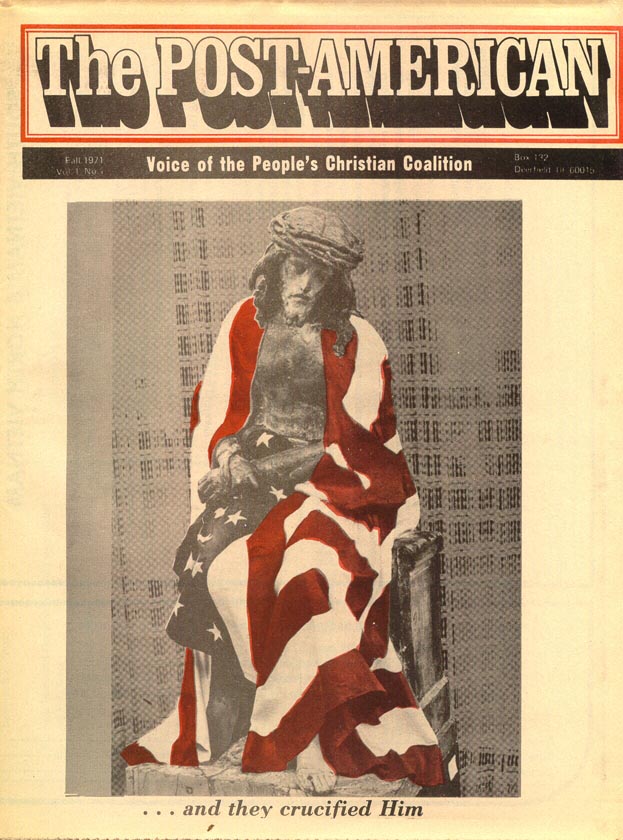
Hatfield’s resonance with the New Left, disgust with the Vietnam War, and distaste for civil religion, however, did not mean that he went all the way with his most radical evangelical comrades. Unlike the Post-Americans, Hatfield never corrupted patriotic phrases—such as “Amerika” or “the American Way of Death”—to express contempt toward the nation. He still saw redemptive potential in the nation and sought to engage American political culture constructively. This impulse, even as he criticized the nation, made Hatfield significant and representative of growing evangelical trends. He sought to repair the nation, to invest it with spiritual resources. He worked his way up state and national political structures, seeking justice from within a corrupt system. Like the religious right that would follow, Hatfield balanced revulsion toward a fallen nation and a compulsion to reshape it.

For a sample of contemporary progressive thoughts on patriotism, check out some of these links:

Progressive evangelical spirituality

I just learned of Jan Johnson, a writer, speaker, and spiritual director. Jan is a good example of a progressive evangelical who takes both social justice and spirituality seriously. She has connections with Fuller Seminary, Azusa Pacific University, World Vision, and other places where moderate and progressive evangelicals hang out. Here’s how she describes her passions:

Spiritual formation: The key to getting rid of stubborn habits and ingrained character flaws – the tendency to criticize, complain and procrastinate — is to build an interactive life with God. Instead of trying to be good, we connect with God in order to let God transform us into Christlikeness. As we do the connecting with God, God does the perfecting in us.

Partnering with God in caring for the voiceless: We can learn to offer cups of cold water to the thirsty, to whisper words of life to the unreached, to love all peoples the way God does, to set aside the pull of materialism and spend our resources on worthwhile purposes. Such a life flows from cherishing the compassionate lifestyle of Jesus and arranging our lives to love this world that God so loves.

Living with Purposeful Intentionality: Life today is characterized by too much activity with too little meaning, on glitz instead of substance.  Focusing on how God is calling me to let my heart be broken by the things that break the heart of God prods me to partner with God in efforts that reconcile people to God, to others and even to themselves. This kind of life is exciting – interacting with God throughout all of life and hear God compel us, comfort us and nudge us along.

To hear her articulate her vision of spirituality, check out this youtube clip:

Toward an Evangelical Peace Movement

Mark down September 14 on your calendar. Evangelical leaders are meeting at Georgetown University for a summit called Evangelicals for Peace: A Summit on Christian Moral Responsibility in the 21st Century. They will seek the following:

• To build and birth a network of evangelical scholars and activists committed to the pursuit of a Biblical, comprehensive, and proactive peace

• To reduce violence, work toward human flourishing, and prevent war

• To mobilize and educate a new generation of evangelicals committed to the pursuit of peace

• To convene a gathering of non-profit and pastoral leaders who are actively working for peace with justice throughout the world

• To give a special focus on peace as it relates to U.S. foreign policy

Read more here.

Evangelicals & Catholics Link Pro-Life Stance to Creation Care

This story in the Huffington Post on a “Joint Declaration on Life” is fascinating on many levels. First, it’s another attempt at the “consistent life ethic” that the evangelical left pursued in the 1980s. In this case, religious activists are linking abortion and environmental degradation. Signatories of the “Joint Declaration on Life” speak of creation care and respect for unborn life. Second, it’s a continuation of one of the most important trajectories of the 20th century: ecumenical activity between evangelicals and Catholics. This began on all points of the political spectrum in the late 1970s with the Moral Majority, Sojourners, and Evangelicals for Social Action.

Supporters of this Declaration include many names found in Moral Minority. They include Shane Claiborne, Wheaton Professor Jeffrey Greenburg, Joel Hunter, David Gushee, Ronald Sider, and Southern Baptist author and spokesman Jonathan Merritt. To see other signatories–or to sign it yourself–click here.

Will this gain traction? Or will it be victimized yet again by an electoral system that doesn’t allow for the evangelical left’s platform of idiosyncratic planks?

Here’s an excerpt:

So that together we may all choose well—and encourage others to do so—we urge understanding and the building of bonds between those who, in their own way and through their own calling by God, seek to champion and defend the great, glorious, and mysterious gift of life—human life, born and unborn, and life throughout all creation, here and now, and for the ages and generations to come, until the end of time.

Snarking Wild Goose

As you can imagine, politically conservative evangelicals often see the evangelical left as a threat. So it’s no surprise to see the arts and faith festival, Wild Goose, come under attack. Leading the charge, as he usually does, is Mark Tooley of the Institute for Religion and Democracy. Every month or two, he writes up an articulate denunciation of Jim Wallis or Maryknoll or Ron Sider or anyone pronouncing themselves both religiously orthodox and politically progressive. Wild Goose, which began today in the hills of North Carolina, has lots of them, including Shane Claiborne, Jonathan Wilson-Hartgrove, Mike and Julie Clawson, Brian McLaren, and Jay Bakker.

Here are some of the juicy quotes (taken from this Christian Post article):

  • Mark Tooley: “Most Religious Left groups that advocated leftist policies in past generations are now in severe decline, and their activists are now targeting evangelical youth.”
  • Ken Silva: “The wise Christian will have nothing to do with these neo-Gnostic fools who’ve unbuckled themselves from the Word of God and have embarked upon their Wild Goose Chase of subjective experience.”
  • Mark Tooley: “Many ‘Wild Goose’ voices flatter themselves with fanciful dreams of sophistication and praise from secular elites. Their 1960s-style hoopla is supposedly updated for the 21st century. But ultimately this featherless old Wild Goose won’t fly.”
  • D.A. Carson: Many of the movement’s thinkers take a reductionistic view of modernism, are dismissive of confessional Christianity, and are reluctant to assert that Christianity is true and authoritative.
  • Mark Tooley: “Wild Goose exemplifies how the Evangelical Left translates ‘social justice’ into Big Government and pacifism.”

Any Wild Goose alums want to tell us about their experiences?

What would Jesus brew?

Here’s another example of “lived religion” among some progressive evangelicals: mixing theology and beer. In this newspaper article (and in his just-released book Confessions of a Bible Thumper: My Homebrewed Quest for a Reasoned Faith, Michael Camp of Washington state describes how conversations in bars increased his faith. “People think you have to go to church to talk theology, but a pub works fine,” Camp said.

This reminds me of my grad school days in South Bend. There was a weekly event at Notre Dame called “Theology on Tap.”