
 Interested in starting an intentional Christian community? I am. If you are too, you should probably consult The Intentional Christian Community Handbook: For Idealists, Hypocrites, and Wannabe Disciples of Jesus. Written by David Janzen, a long-time member of Reba Place, the book addresses both theoretical and practical issues of family, accountability, eating together, work schedules, decision-making, spiritual practices, and gender.
Old Obama and Old Romney
Bloomberg Business projects what Obama and Romney would look like after four years of the presidency. Given the stresses and severe aging effect of the job, did either one of these guys really want to be president?


Election Day Communion–Lexington

Meet at the Asbury main circle at 6:15 p.m. or go directly to Lexington by 7 p.m. For more information, click here.
God is still not a Republican or Democrat
 As the election wraps up, two prominent characters in Moral Minority have issued a plea for civility and compassion in the Huffington Post. Echoing the old bumper sticker that reflects the politically homeless nature of the evangelical left, Jim Wallis and Wes Granberg-Michaelson insist that “God is still not a Republican or a Democrat.” While critics might argue that Wallis and Michaelson have thrown their lots with the Democrats (and I’d be very surprised if they haven’t), I’d still suggest that each feels a deep ambivalence about voting for a pro-choice president who continues to bomb with drones. Here’s an excerpt:
And because no candidate or party comes close to expressing all of our values, we need to respect the different choices that Christians make. For all of us believers, we pray that acts of citizenship may reflect, above all else, allegiance to a vision announcing that God’s love and justice continually seeks ways to break into this world.
MSNBC interview
Yesterday I drove into the public television station KET in Lexington, got worked on by a makeup artist, sat in a green room that wasn’t green, sat down behind a desk on a futuristic set in a cavernous tv studio, had technicians string piles of wire up and down my shirt, and then waited . . . for a full 30 minutes until a producer suddenly said, “Here we go!” Then four cohosts of “The Cycle” started asking me questions as I stared into a big camera lens fifteen feet in front of me. They sure didn’t make it easy on me, asking questions about abortion and gay marriage. 🙂 But the conversation went pretty well, I thought, though much of the material wasn’t what I expected. At one point the audio went out on me, and I couldn’t hear what was happening in New York, and then at the end, the producer started yelling “Wrap, wrap!” into my earpiece to signal that I needed to stop right away. A lot of technicians and a lot of tense moments–all to produce three minutes of television!

Christianity Today reviews Moral Minority
Very nice review over at Christianity Today. Here’s a taste:
Swartz has produced a must read not only for those interested in American religion and politics, but also for students of global Christianity. In relatively short order (the book’s main text comes in at 266 pages), Swartz gives a richly textured narrative of some of evangelicalism’s brightest thinkers, most creative activists, and most controversial provocateurs.
Tim Kaine
 Tim Kaine, the former governor of Virginia and chair of the Democratic National Committee, is an anti-capital punishment, Midwestern social-justice, faithful Catholic Democrat in a socially conservative southern state. How does he pull it off? Find out in this fascinating profile in the Washington Post.
St. Augustine on musical farting
This really has nothing to do with anything. But this kind of potty humor is pretty funny coming from a renowned theologian. I never expected that my four kids under the age of six would remind me of St. Augustine!
“We do in fact find among human beings some individuals with natural abilities very different from the rest of mankind and remarkable by their very rarity. Such people can do some things with their body which are for others utterly impossible and well-nigh incredible when they are reported. Some people can even move their ears, either one at a time or both together. Others without moving the head can bring the whole scalp-all the part covered with hair-down towards the forehead and bring it back again at will. Some can swallow an incredible number of various articles and then with a slight contraction of the diaphragm, can produce, as if out of a bag, any article they please, in perfect condition. There are others who imitate the cries of birds and beasts and the voices of any other men, reproducing them so accurately as to be quite indistinguishable from the originals, unless they are seen. A number of people produce at will such musical sounds from their behind (without any stink) that they seem to be singing from the region. I know from my own experience of a man who used to sweat whenever he chose; and it is a well-known fact that some people can weep at will and shed floods of tears.” (Augustine, City of God, xiv.24)
HT: Running Heads
George McGovern (1922-2012)
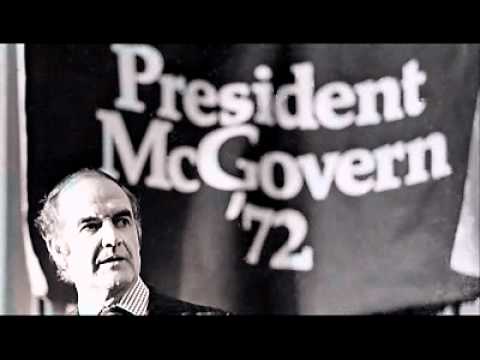 George McGovern, an antiwar politician in the 1970s and Democratic candidate for president in 1972, died yesterday. See some helpful commentary here, here, and here. McGovern is important in the narrative of the evangelical left. In fact, the group Evangelicals for McGovern led directly to Evangelicals for Social Action, which is celebrating its 40th anniversary next year. Here’s an excerpt from Moral Minority:
In August 1972 Messiah College professor Ron Sider opened a letter that asked for donations toward Mark Hatfield’s re-election campaign for the U. S. Senate. After sending in some money, Sider asked himself, “Why can’t we do the same thing for the Democratic Presidential candidate, George McGovern?” In September, Evangelicals for McGovern (EFM) was born among a small circle of evangelical social activists in Sider’s Philadelphia home. As the effort turned national in the following months, many in both the press and the evangelical communities took note. Not only was this the first explicitly evangelical organization in postwar American politics to officially support a presidential candidate, EFM was endorsing a liberal Democrat.
Progressive evangelicals found McGovern’s political ideology far more congenial to their own reformist impulses than Nixon’s. “We like the way McGovern is getting his feet dirty. He’s concerned about hunger, war, poverty and ecology,” explained Wheaton professor Robert Webber to a Newsweekreporter. Jim Wallis, who served as a regional manager for McGovern’s campaign, called the candidate “a first ray of hope in the midst of widespread despair.” Official EFM documents praised McGovern’s evangelical background, his religious rhetoric, and his stances on school busing, poverty, and the war. “A rising tide of younger evangelicals,” asserted an early news release, “feels that the time has come to dispel the old stereotype that evangelical theology entails unconcern toward the poor, blacks and other minorities, and the needs of the Third World.”
Ron Sider, president of ESA, to retire
 Ron Sider, one of the main characters in Moral Minority, yesterday announced his retirement from Evangelicals for Social Action. He will step down in June 2013 and be replaced by Al Tizon and Paul Alexander (I’ll have more to say about them down the road). Read the news reports here and here.
Here are two excerpts from the manuscript. The first is from the introduction and describes how Sider helped launch the evangelical left of the 1970s:
Ron Sider promoted a Swiss-German Anabaptist strain of progressive evangelicalism. Author of the best-selling book Rich Christians in an Age of Hunger, Sider espoused an ethic of simple living that extended the critique offered by third-world evangelicals. He also followed Senator Mark Hatfield’s lead into electoral politics. In 1972 Sider founded Evangelicals for McGovern, a group that campaigned on behalf of Democratic candidate George McGovern. This effort led directly to the first organized gathering of the evangelical left.
The second is from the epilogue, where I push Sider’s story forward to the present day:
Ron Sider, leader of the Thanksgiving Workshop, continued to preach Anabaptist messages of justice, peace, and simple living to evangelicals. Rich Christians in an Age of Hunger, which catapulted Sider to prominence,sold nearly half a million copies by its fifth edition. As president of Evangelicals for Social Action and a professor of theology, holistic ministry, and public policy at Palmer Theological Seminary, he helped launch the Evangelical Environmental Network. In the early 1990s EEN campaigned for and donated $1 million to preserve the Endangered Species Act and in the early 2000s launched a “What Would Jesus Drive?” campaign, which garnered articles in at least 4,000 media outlets over four months. With the exception of his pro-life stance, support for school vouchers, and 2000 vote for George W. Bush’s “compassionate conservatism” (which he later said he regretted), Sider, like Sojourners’ Jim Wallis, routinely embraced Democratic policies. Yet ESA, characterized by Sider’s warm and conciliatory personality, can be distinguished from Sojourners’ more partisan style. Into the 2000s Sider and his wife Arbutus, a family therapist, still practiced simple living. They cooked out of the More-with-Less cookbook, by then in its 47th printing. They purchased most of their clothes at thrift stores and maintained a modest home in a mostly black neighborhood in the Germantown section of Philadelphia. The décor, reported a journalist, was comfortably worn, falling “somewhere between Graduate Student and Junior Faculty.”

