The prophetic engagement of Clarence Jordan and Koinonia Farm

In 1942 Clarence Jordan moved to rural Georgia. He started a farm called Koinonia. He was a careful steward of the land. He and his colleagues helped launch Habitat for Humanity. Most significantly, he invited blacks to join his intentional community. This was when the South was segregated, so this was a stiff challenge to racial segregation. When people didn’t like it and began bombing the farm, he didn’t withdraw. He responded with love and prophetic engagement, creating a little glimpse of the kingdom at Koinonia.

You can imagine that progressive evangelicals have long admired Jordan. Many of them will converge on Koinonia Farm this fall to celebrate the community’s 70th anniversary.

The evangelical left and Paul Ryan

CNN was quick to check in with progressive evangelicals on their reaction to Romney’s pick of Ryan. Here’s a taste:

The Democratic organizations, including progressive Evangelical Christian groups, have criticized Ryan’s principles and his budget proposals they say will negatively impact the poor’s safety net.

A video released by American Values Network linked Ryan, the Wisconsin congressman, to author Ayn Rand to make their point.

While Rand supported individual rights and limited government, she also largely rejected faith and religion.

The spot quotes Rand saying “I don’t approve of religion, it’s a sign of a psychological weakness.”

Ryan, a practicing Catholic, is subsequently quoted praising the writer, who passed away in 1982.

“Ayn Rand more than anyone else did a fantastic job of explaining the morality of capitalism, the morality individualism and this to me is what matters most,” Ryan says in the commercial.

The narrator then asks, “What matters most to you?”

And here’s the video:

A short hiatus

I’ll be traveling to Goshen, Indiana, tomorrow to attend a Mennonite conference where I’ll be giving a couple of talks on “People of Peace in a Violent World.” From there, my wife Lisa and I will head to Chicago for a working vacation. It’s a vacation because my parents will be watching our four young children (and four of their cousins) for the fifth annual Cousin Week. It’s a working vacation because I’ll be researching my second book project at the Wheaton archives, and Lisa will be studying hard for her comprehensive exams in sociology. Don’t worry–we’ll take the evenings off and have a good time in downtown Chicago. All that to say: posting may be a bit sporadic over the next week.

In the meantime–and in the spirit of Anabaptism–check out this recent post at “Q” by Nancy Sleeth. It’s about her recent book Almost Amish: 10 Principles for a Slower, Simpler, More Sustainable Life.


Make Hummus Not War

Could hummus be the recipe for peace in the Middle East? A voice in this documentary says yes: “When you eat together, you can’t betray each other.”

If you love hummus as much as I do, take a look at the trailer, look at the producer’s website, join their facebook page, and check out one of my favorite blogs The Hummus Blog: Eat Hummus, Give Chickpeas a Chance.

Prophetic Evangelicals

Check out this review at Englewood of Prophetic Evangelicals: Envisioning a Just and Peaceable Kingdom, due out next month from Eerdmans. It includes lots of important young and minority voices including Malinda Berry, Peter Heltzel, Bruce Benson, David Gushee, Chris Boesel, and Ruth Padilla-DeBorst, among others. Here is Daniel Yencich’s critical summation to an otherwise very positive review:

For all the strength in its various essays, Prophetic Evangelicals is not without its questionable assumptions and unhelpful assertions. Though there are contributors who resist this trend, Prophetic Evangelicals as a whole seems most at home among those evangelicals who lean to the left, both politically and theologically. What this amounts to at times is a solid critique of conservatism (which is welcome!), but only a rather soft-handed prodding of liberalism (which, frankly, is not enough). Political conservativism and liberalism are both sources and perpetrators of great evil in the world today; a bit more balance in the prophecy against the two sides of the aisle would have been more helpful.

A New Evangelical Manifesto

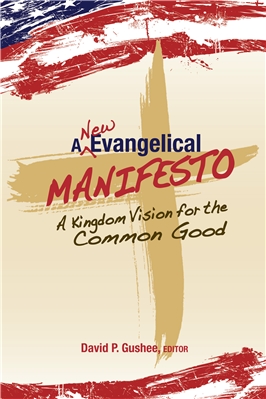
I’ve blogged before about the New Evangelical Partnership for the Common Good. Led by Richard Cizik and David Gushee, the NEPCG is releasing an important new book next month. Publicity copy for A New Evangelical Manifesto says that the book seeks to “think differently about how conservative faith relates to politics.” I expect that it will echo many of the same “consistent life” themes of the old evangelical left, but most of the names are new. I’m eager to read it!

Here’s the Table of Contents:

Introduction. David P. Gushee

Section I: A New Kind of Evangelical Christianity…
1. The Church in America Today (Brian McLaren)
2. Where the Church Went Wrong (Steven Martin)
3. A Disenchanted Text: Where Evangelicals Went Wrong with The Bible (Cheryl Bridges Johns)
4. My Journey Toward the “New Evangelicalism” (Richard Cizik)
5. A Theology That “Works” (Paul Markham)
6. God’s Vision for the Church—Kingdom Discipleship (Glen Harold Stassen)
7. Kingdom Community (Steven Martin)

Section II: Leading to Holistic Love of Marginalized Neighbors, such as…
8. Those Trafficked and Commodified (Jennifer Crumpton)
9. Those Suffering Preventable Diseases (Andi Thomas Sullivan)
10. Our Muslim Neighbors (Rick Love)
11. People of All Races (Lisa Sharon Harper )
12. Women (Jennifer Crumpton)
13. Children (Laura Rector)
14. The Dying (Scott Claybrook)
15. The Global Poor (Adam Phillips)

Section III: …And Redemptive Approaches in Public Life
16: Ending the Death Penalty (Timothy W. Floyd)
17: Making Peace (Paul Alexander)
18: Abolishing Nuclear Weapons (Tyler Wigg-Stevenson)
19: Overcoming Global Warming (Jim Ball)
20: Reducing Abortion (Charlie Camosy)
21: Resisting Consumerism (Jennifer Crumpton )
22: Standing Fast Against Torture (David P. Gushee)

On the decline of liberal religion


Ross Douthat, conservative columnist for the New York Times

In his July 14, 2012, column, “Can Liberal Religion Be Saved?” Ross Douthat mourns a lack of religious options. He indicts liberal religion for its relativism and secularism. He paints conservative religion as compromised by a heretical health-and-wealth theology. But this dichotomy betrays a lack of imagination. Obscured by the unrelenting culture wars, an evangelical left has sought for several decades now to pave a third way. Theologically conservative, but politically progressive evangelicals have allied with moderate Catholics around a “consistent life ethic.”  They have defied political orthodoxies in their attacks on abortion, capital punishment, poverty, nuclear proliferation, and spiritual malaise. In an era plagued by the dislocations of modernity and the relativism of postmodernity, mainliners and fundamentalists might do well to follow the lead of progressive evangelicals in emphasizing both social reform and personal conversion.

For similar thoughts by Rachel Held Evans, click here.

And here Diana Butler Bass points out that liberals are not the only ones losing adherents. Conservatives are too.

Duh!

Michael Westmoreland-White

Michael Westmoreland-White responds with a “Duh!” to my claim that the evangelical left hasn’t thrived became of their discomfort with the very term evangelical. And he follows with a very helpful biographical narrative and expansion of the basic point. Go check it out here.

Is this surprising? When I was a teen in the 1970s, it was fairly easy to call myself “evangelical” and to identify with the Evangelical Left as it was then: Jim Wallis, Joyce Hollyday & the Sojourners Community; Tony Campolo; Ron Sider & Evangelicals for Social Action; Koinonia Partners in Americus, GA, founded in 1942 by Clarence & Florence Jordan & Martin & Mable England as an interracial Christian community–in the midst of segregation and racism; Jubilee Partners and The Other Side magazine (1965-2005); Virginia Ramey Mollenkott; Nancey Hardesty; Letha Dawson Scanzoni–Biblical feminism and the Evangelical Woman’s Conference (now the Evangelical and Ecumenical Woman’s Conference); the radical Black evangelism of Tom Skinner, John Perkins (and Voice of Calvary Ministries), and William E. Pannell–these and other people and organizations were the Left wing of American Evangelicalism, but clearly recognized as evangelical by their more moderate and even conservative sisters and brothers.

I LIKE the term “evangelical.” It literally means “gospel centered” & I, like most Christians, want to be “gospel centered.”. . . BUT “I am NOT “evangelical” in the sense the word aquired after the Furndamentalist-Modernist controversy of the 1920s and definitely not in the sense of the Religious Right. And my theology, while having many influences from the Evangelical tradition as described above, has other influences too: from the Anabaptist tradition and the Anabaptist strand of the Baptist faith, from the more Christocentric strands of Protestant liberalism, from some forms of Neorthodoxy and the post-WWII “Biblical Theology” movement, from Liberation theologies and theologies of Hope, etc.  If one has to avoid all such influences to be genuinely “Evangelical, then I am NOT Evangelical.  If one must be conservative politically, then I, a Green-leaning democratic socialist and registered Democrat, fail the test.

Richard Mouw and the evangelical label

Richard Mouw, president of Fuller Theological Seminary

One of the reasons for the failure of the evangelical left to thrive is that many are uncomfortable with the evangelical label. Associating the label with right-wing, militant rhetoric, many progressive evangelical now call themselves other things entirely, even though they might agree with Richard Mouw’s description of evangelical identity below:

The important question that we do need to ask about labels, of course, is whether they continue to communicate what they were originally intended to identify. In that regard, questions about the “evangelical” label are good ones to ask today. And while I take those questions seriously, I am firmly committed to sticking with that label as a means of self-identification. . . . For me evangelical identity points to such things as a firm belief in the supreme authority of the Bible and the unique atoning work of Jesus Christ, as well as to the obligation to work actively in inviting people to enter into a personal relationship with the Savior. And furthermore, it means continuing to plead with others who own the label not to pile onto those important convictions a lot of additional baggage that does not do honor to a label that I continue to love.

Click here for more.